Painting
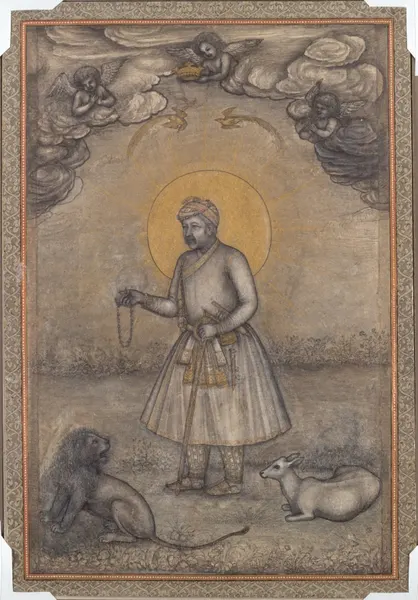
Portrait of the Aged Akbar
Govardhan
c. 1640–50
From the archive
The soulful modeling of Akbar’s aged but dignified face argues strongly in favor of the attribution of this work to the imperial court artist Govardhan. This posthumous portrait of the celebrated third Mughal emperor would have been made at the end of his career for Akbar’s grandson Shah Jahan, who reigned from 1626 to 1648. Shah Jahan glorifies his own august lineage by lionizing Akbar and having him portrayed in a formal, symbolic way that Akbar himself never would have commissioned. Christian angels in European style praise him from the heavens, while mythical birds of paradise swoop at the edge of the radiance emitted from the nimbus of the divine light of his rule. He originally grasped an orb, which was changed to a necklace. The sensitively articulated body of a young cow reclines at ease in the presence of a lion, indicating the harmony and peace of his noble rule. The artist used the dignified nim-qalam style of painted drawing with only touches of gold and hints of color. Heavy outlines were added at a later date, along with pinprick holes used for copying the composition onto another sheet of paper.
- Associated place
- India
- Material & technique
- Gum tempera and gold on paper
The record behind the work
Place & date
The museum gives the cultural attribution “India, Mughal court, 17th century”. The pin represents this broad cultural association, not a verified creation site or depicted location.
The archive gives an approximate date or a range of years. The timeline uses that same range.
Source & reuse
Cleveland Museum of Art ↗
Source ID: 146185
CC0 — image and metadata released under the Cleveland Museum of Art Open Access program. Published from the United States.