Literature
Burning and melting
Muḥammad Riz̤ā Nawʿī Khabūshānī
1st Ṣafar 1068 AH / November 1657 CE
From the archive
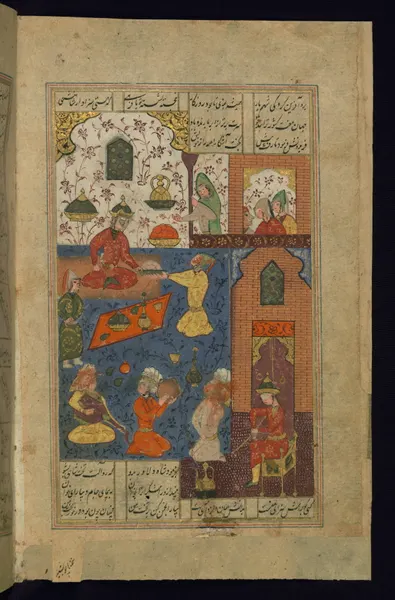
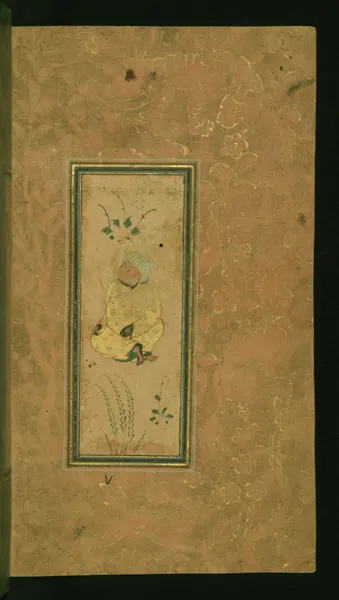
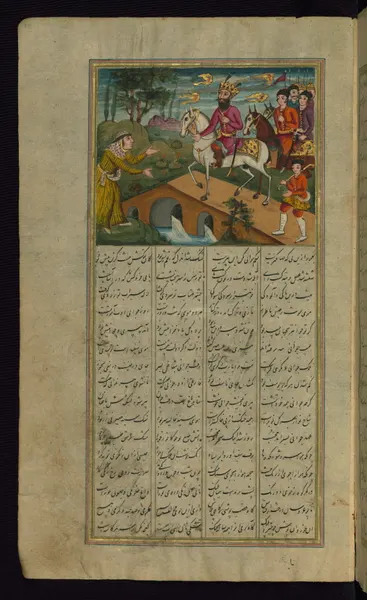
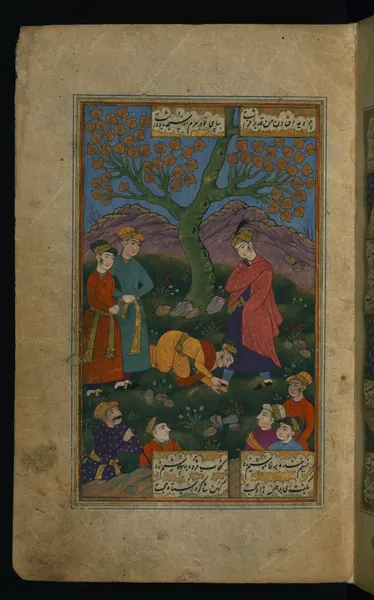
This is an illuminated and illustrated copy of the poem Sūz va gudāz (Burning and melting) by Nawʿī Khabūshānī (d. 1019 AH / 1610 CE), which recounts the love story of a Hindu girl who burns herself on the funeral pyre of her betrothed. The codex was written in nastaʿlīq in black ink by Ibn Sayyid Murād al-Ḥusaynī and illustrated by Muḥammad ʿAlī Mashhadī in 1068 AH / 1657 CE. According to the colophon, Ibn Sayyid Murād al-Ḥusaynī copied the manuscript for the painter Muḥammad ʿAlī, the “Mani of the time,” as a “souvenir.” The fact that the manuscript was produced for one of the most prolific artists of seventeenth-century Iran makes it a highly significant document. It opens with an illuminated incipit with headpiece (fol. 1b) and closes with an illuminated tailpiece with colophon (fol. 21b). Text pages have interlinear illumination and small rectangular and triangular pieces with polychrome floral and scrolling vine motifs. There are eight miniatures in a style associated with the Safavid centers of artistic production of Mashhad and Isfahan (fols. 5a, 9a, 10b, 13a, 14a, 16a, 17b, and 19b).
- Place of origin
- Iran
- Language
- The primary language in this manuscript is Persian.
The record behind the work
Place & date
Manuscript TEI origin: “Iran”. Dates describe this physical manuscript, not the author's life or the work's first composition.
Source & reuse
Walters Art Museum ↗
Source ID: W.649
CC0 — digitized manuscript images and catalog metadata from The Walters Art Museum, United States.
CC0 — The Walters Art Museum