Print & drawing
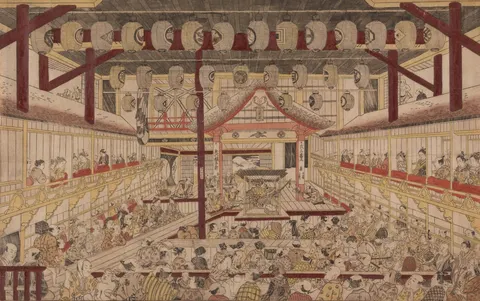
Perspective View of the Interior of the Nakamura Theater with Ichikawa Ebizo II as Yanone Goro
Okumura Masanobu
1740
From the archive
The print illustrates the typical interior of a Kabuki theater. The stage was connected to the audience by the hanamichi , the ramp or runway extending from the stage to the rear of the theater over which the actors would strut in dramatic roles. Patrons often stayed all day for the plays. Unlike quiet Western audiences, Kabuki fans were spirited, buying food from vendors and even shouting praises to their favorite actors as they came onto the stage. In 1734, the first Japanese manual on perspective was printed. Masanobu was probably the first printmaker to use this method of describing three-dimensional space on a two-dimensional support. He helped popularize the perspective print, and he introduced other innovations such as two-color printing and hand-coloring—this print is hand-colored using yellow, red (tan), and red-brown.
- Associated place
- Japan
- Material & technique
- hand-colored woodblock print
The record behind the work
Place & date
The museum gives the cultural attribution “Japan, Edo period (1615–1868)”. The pin represents this broad cultural association, not a verified creation site or depicted location.
Source & reuse
Cleveland Museum of Art ↗
Source ID: 95401
CC0 — image and metadata released under the Cleveland Museum of Art Open Access program. Published from the United States.